01
02
03
04
05
Performing Legal Research with Alexi
Alexi was built on a strong foundation of legal research, and is able to answer your legal research questions with speed and accuracy, referencing only authoritative, relevant sources that include caselaw, statute/legislation and even some secondary sources.
To trigger Alexi’s legal research function, simply ask any question about the law.
What does an Ideal Input Include?
An ideal research input consists of 3 basic elements:
- Context - Tell Alexi about the file you’re working on, or the work you’re trying to perform.
- Goal - Describe what your ideal outcome would look like.
- Instructions - Provide a task for Alexi to complete (such as finding caselaw, answering a question, helping you strategize etc.)
Here is an example:
I'm working on a commercial litigation file where my client, a supplier of automotive parts, is being sued for breach of contract after allegedly failing to deliver goods on time. My goal is to understand whether the force majeure clause can shield my client from liability in these circumstances and to find supporting case law. Please find examples of cases where force majeure was successfully invoked due to government-imposed shutdowns or similar disruptions in commercial supply agreements.
How can I ask Follow-Up Questions and Iterate?
Think of your interaction with Alexi as a conversation, not a one-time search. The best way to get useful answers is to:
- Start broad – Begin with a general question to get an overview.
- Narrow down – Use Alexi’s first answer to identify areas you want more detail on.
- Ask follow-ups – Build on the previous answers by asking more specific questions.
- Refine further – Continue until you have the clarity, level of detail, or format you need.
This step-by-step approach mirrors how you would research a topic with a colleague: start wide, then zoom in until you have the precise answer.
Here’s an example:
Step 1 – Start Broad
What is the legal framework governing misrepresentation in commercial contract disputes in Ontario?
Step 2 – Narrow Down
Can you break down the key differences between fraudulent, negligent, and innocent misrepresentation under Ontario law?
Step 3 – Follow Up
Can you provide examples of commercial cases where negligent misrepresentation was successfully pleaded despite the existence of an integration clause?
Step 4 – Refine Further
What about where the misrepresentation involved projected future earnings during pre-contractual negotiations for a commercial lease agreement?
—--
Activity Log
The Activity Log offers visibility into how Alexi arrives at its answer. We give you a peek “under the hood” into Alexi’s process for answering questions - including its analysis, evaluation of the authoritativeness and relevance of sources, and synthesis of answers. This allows you to understand Alexi’s reasoning, verify accuracy, and trust its output.
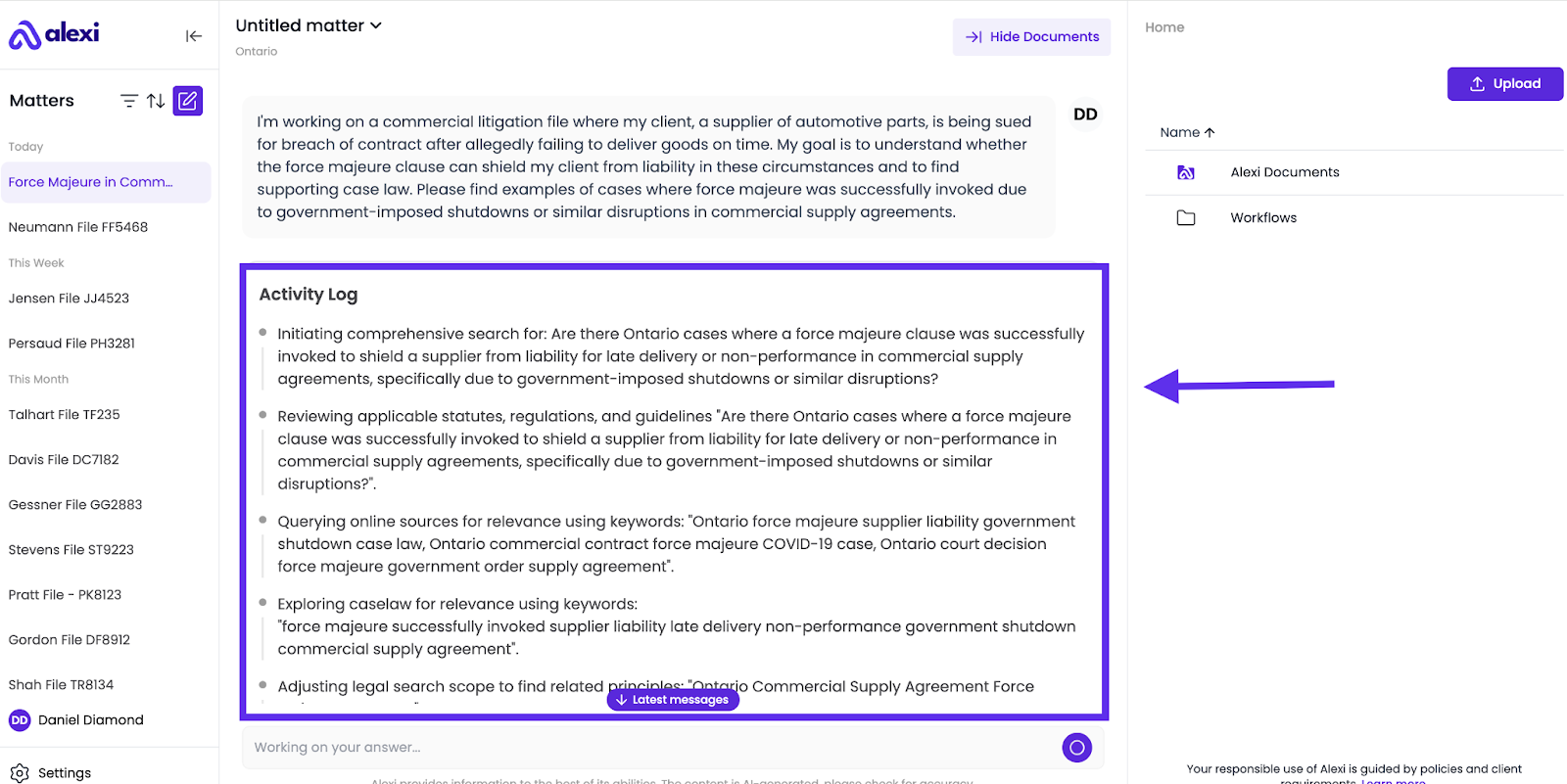
Why this matters
- Transparency: Understand exactly how Alexi arrived at its conclusions.
- Accuracy: Verify that the AI referenced the correct documents and legal sources.
- Learning tool: See how AI interprets questions and structures responses, which can improve how you phrase your future queries.
- Audit trail: Provides a documented record of AI reasoning for client work, compliance, or internal review.
Referenced Cases
This section demonstrates how Alexi links its responses to legal authorities. Alexi provides relevant cases in the Referenced Cases folder, offering immediate access to the legal authorities behind its responses.
Here’s a short video showing you how to find referenced cases within Alexi.
To view referenced cases:
- After Alexi generates an answer, navigate to the right navigation panel and click on the Alexi Documents Folder.
- Click on Referenced Cases.
- Inside the folder, you’ll see a list of all cases Alexi relied on to generate your answer, all hyperlinked - so you can deep-dive on each case if needed.

Why this matters
- Transparency: You can validate where Alexi’ answers are coming from.
- Efficiency: No need to run separate case searches, Alexi does the heavy lifting.
- Reliability: Case law references help you confirm that Alexi’s response align with actual legal authorities.
- Quick navigation: Having all cases grouped in one folder saves time when preparing memos, drafting arguments, or checking citations.
FAQ
Does Alexi always provide cases?
Not always. Alexi pulls cases when your question is legal in nature and case law is relevant. For general drafting, brainstorming or business questions, there may not be cited authorities.
Can I click directly into the case?
Yes. Referenced cases are hyperlinked so you can view summaries or passages directly alongside Alexi’s reasoning.
Are these cases always binding?
Alexi surfaces the most relevant authorities based on a number of factors including level of court, similarity to your fact pattern or context, relevance to the legal issues, frequency of citation by other cases, and a variety of other factors. Some of these factors may outweigh the others when determining relevance. Always apply professional judgment when relying on them.
What if I need more depth on a specific case?
To explore a specific case in more detail, you can refer to it within your follow-up question. For example, you can ask, In the Jones decision, what were the facts of the case and how are they potentially distinguishable from my own case?